Premium raw materials manufactured and supplied with strict compliance standards.
Understanding the core science of lipid-degrading enzymes for high-performance industrial processes.
Lipases (triacylglycerol acylhydrolase, EC 3.1.1.3) are carboxyl ester hydrolases that act on ester bonds of water-insoluble fatty acid substrates. The lipase activity determines the speed and efficiency with which this enzyme breaks down triglycerides into glycerol and free fatty acids. Measuring this activity is vital for industrial processes, as variations in pH, temperature, and substrate concentration can drastically alter enzyme kinetics.
Unlike simple esterases, true lipases exhibit a unique physical characteristic known as interfacial activation. This occurs when the enzyme's catalytic site is exposed after a structural conformational change, shifting a protein "lid" away upon contact with the lipid-water interface. As a leading OEM Lipase activity Manufacturer & Manufacturers, our formulation techniques ensure that this interfacial mechanism is preserved and optimized for target industrial substrates.
| Industrial Requirement | Optimal Lipase Source | Typical Activity Ranges (U/g) | Preferred Formulation State |
|---|---|---|---|
| Detergents & Cleaners | Pseudomonas sp. / Bacillus | 50,000 – 150,000 U/g | Granular / Liquid Concentrate |
| Food processing & Baking | Aspergillus niger | 10,000 – 80,000 U/g | Water-soluble Powder |
| Biodiesel Synthesis | Candida rugosa / antarctica | 100,000 – 500,000 U/g | Immobilized on silica/polymer beads |
| Cosmetics (Ester synthesis) | Thermomyces lanuginosus | 20,000 – 100,000 U/g | Liquid dispersion / powder form |
How supply chain managers evaluate custom enzymatic formulations for stability and cost-efficiency.
Procurement departments prioritize verified biological assay methodologies. The standard Olive Oil titration method (pH-stat) determines the exact lipase activity values under standardized parameters. When sourcing from an OEM manufacturer, requesting Certificate of Analysis (COA) records matching strict USP/FCC criteria ensures consistent efficacy.
Enzymes are highly selective. Depending on whether you require 1,3-specific, 2-specific, or non-specific lipases, the fermentation strains must be tailored. Finding a flexible OEM manufacturer with broad genetic strain libraries allows buyers to request targeted positional selectivities (regioselectivity) for lipid transformations.
Free enzymes can be easily inactivated by harsh solvents or thermal changes. The current global sourcing trend shows high demand for immobilized lipases, which can be easily separated from reaction media and reused for up to 100+ cycles, dramatically reducing the operational cost per ton of raw material.
Our systematic strategy for strain engineering, high-density fermentation, and enzymatic stabilization.
The production of industrial enzymes requires highly efficient expression hosts. We utilize genetically modified strains of Aspergillus oryzae, Pichia pastoris, and Bacillus subtilis to increase intracellular synthesis and extracellular secretion rates. Utilizing CRISPR-Cas9 genome editing allows us to insert promoter sequences that boost standard production capacities.
Our facility runs automated, computerized fed-batch fermentation setups. Controlling parameters like dissolved oxygen (DO), pH profile curves, and nutrient feeding speeds guarantees batch-to-batch consistency. Downstream processes involve:
From environmental remediation to clinical-grade dietary supplements, explore practical industrial applications.
Chemical catalysts for biodiesel synthesis require highly refined oils and high energy input. Our custom immobilized lipases enable the direct transesterification of low-cost, high-acid waste cooking oils into biodiesel under ambient conditions, preventing soap formation and cutting chemical refining steps.
In industrial baking, lipases modify endogenous wheat lipids to create polar lipids that mimic chemical emulsifiers like DATEM. This increases dough stability, yields finer crumb structures, and extends product shelf life without using artificial chemical food additives.
Our enzymes synthesize pure, allergen-free emollient esters like isopropyl myristate under mild reaction parameters. Furthermore, lipases are highly requested in personal care formulations to balance sebum production and support natural skin-barrier function.
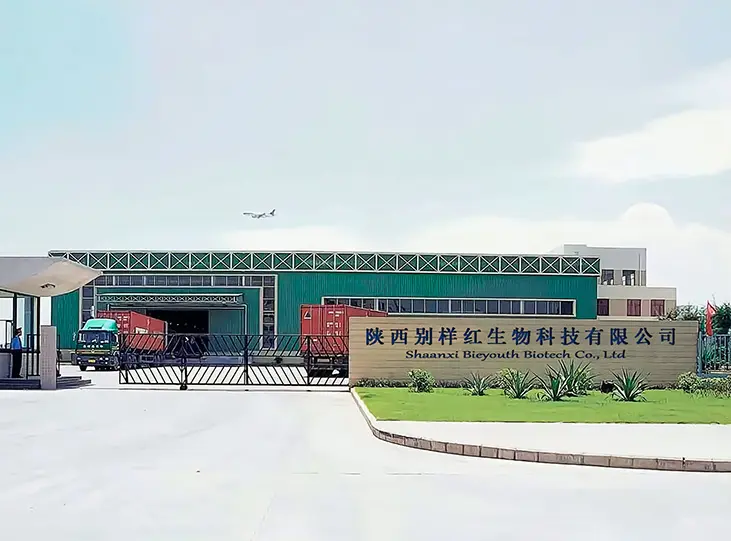
Shaanxi Bieyouth Biotech Co., Ltd. was established in 2018, with too many years of experience in foreign trade import and export. It is a large-scale gold supplier integrating production and sales. We mainly do plant and animal extracts, food additives, cosmetic raw materials and pharmaceutical raw materials. Our production facilities are GMP certified, with two standardized production workshops and advanced extraction equipment. Our products are exported to the United States, the United Kingdom, Canada, Russia, Australia and other parts of the world.
Management of complete quality control measures.
We offer private label packaging service for every product.
Our journey of standardizing enzyme systems and plant extracts for worldwide supply chains.
Participated in Shanghai International Cosmetics, Personal and Home Care Raw Materials Exhibition to present next-generation cosmetic enzyme solutions and plant-derived peptide materials.
Obtained the FDA certificate certified by the US Food and Drug Administration, streamlining distribution across North American biological feed, cosmetic, and nutritional markets.
Launched wide-reaching foreign trade business operations, establishing shipping hubs for international cargo. During the same period, built our specialized Institute of Biology to expand research into active cosmetic ingredients.
Recognized as an "Integrity Enterprise" and "Quality Assured Enterprise" due to our rigorous 5-level QC processes and chemical analysis audits.
We meticulously select our raw materials and strictly control our advanced production processes, constantly striving to improve our technology to achieve excellence.
Published: June 12, 2026
Published: June 12, 2026
Published: June 12, 2026
Our dedicated biological engineers, customer agents, and export specialists work in tandem to meet your chemical standards.







We provide full-spectrum engineering to transition your initial requirements into scaled biological products.
We initiate with in-depth discussions to understand client requirements, including product specifications, quality benchmarks, lipase activity values (U/g), target pH, and volume expectations.
Based on client specifications, we either produce according to provided designs in OEM or take on the full design and development process in ODM, leveraging our bio-catalytic expertise to formulate unique products.
We craft biological prototypes for client approval, ensuring the activity levels, solubility, and thermal traits meet desired specifications before starting bulk industrial runs.

Established in 2018, we bring over five years of experience in foreign trade import and export to the table.

Our production facilities are GMP certified, ensuring the highest standards of product quality.

We specialize in green, healthy, and natural product manufacturing, providing customized OEM solutions.

As a source factory, we offer competitive prices and rapid response times.
Ensuring complete batch tracing, safety data sheets, and regulatory validation for global imports.
Operating across strict jurisdictions requires complete clarity regarding biological raw materials. For every order of custom lipase or biochemical raw materials, Shaanxi Bieyouth Biotech provides:
Enzymatic activity can decline if subjected to high heat during transit. To safeguard your active raw materials, we use climate-controlled packaging and refrigerated supply routes for sea, air, and express shipments.
"Our primary objective is to maintain biological structural integrity during international shipping, ensuring your products arrive with their certified activity assays fully intact."
Scientific and logistical details regarding custom enzyme activity, OEM procedures, and storage guidelines.
Premium functional ingredients and raw materials sourced from our certified production workshops.
 Bieyouth